
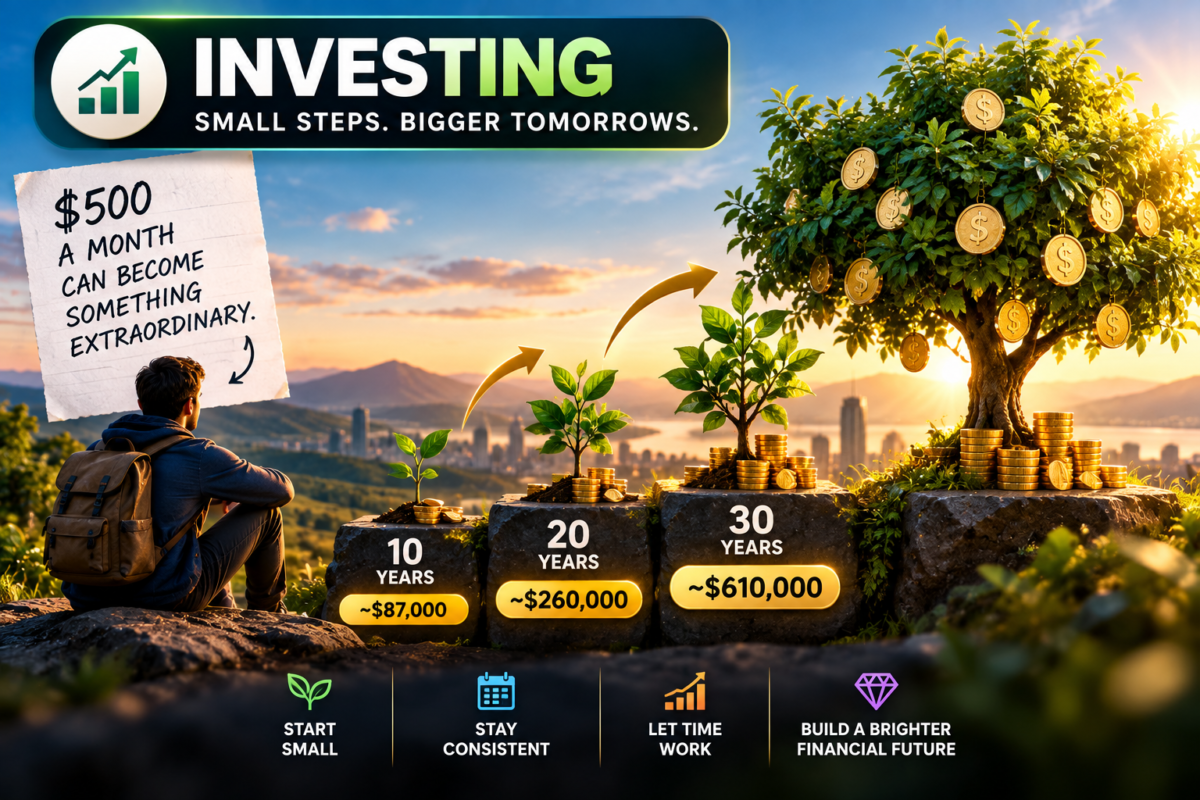
$500 doesn’t feel life-changing.
It can disappear into a car payment, restaurants, subscriptions and everyday spending without attracting much attention.
But investing works differently because time changes what $500 means.
Suppose someone invests:
$500 every month
and earns an illustrative 7% annual return over the long term.
They contribute:
10 years → $60,000
20 years → $120,000
30 years → $180,000
But if those contributions compound at the assumed return, the ending values are roughly:
10 years → $87,000
20 years → $260,000
30 years → $610,000
The person only contributed about $180,000 over 30 years.
The rest of the projected value comes from investment growth.
Of course, 7% is only an assumption—not a promise. Real investments fluctuate, fees matter, taxes can matter, and future returns are unknown.
But the lesson isn’t:
Find an investment returning exactly 7%.
The lesson is:
Small amounts + consistency + time can become large amounts.
The mistake people make
People naturally pay attention to large numbers today.
$50,000 looks important.
$500 looks small.
Compounding makes you think differently.
The important question becomes:
“How many years does this money have?”
A 25-year-old and a 55-year-old can invest the same $500.
But the money has very different amounts of time to grow.
That’s why waiting for the “perfect investment” can have a hidden cost:
lost time.
Nirvair takeaway
Don’t only ask:
“How much am I investing?”
Also ask:
“How long will I leave it invested?”
Calculator CTA
What could your monthly investment become?
Try $100, $250, $500 or your actual amount—and change the time, return, fees and inflation assumptions.