
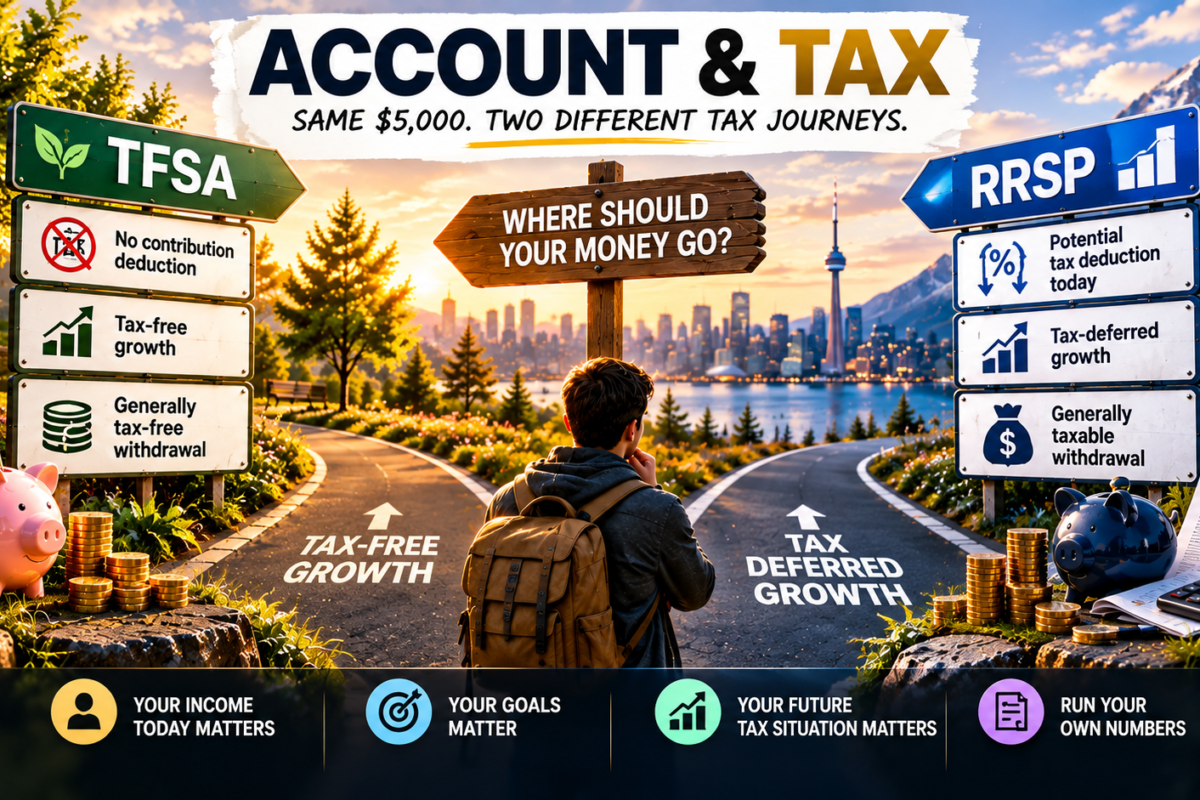
You have $5,000.
Two buttons are in front of you:
TFSA
or
RRSP
Which one should you press?
This is where many people make the wrong comparison.
They ask:
“Which account gives better investment returns?”
But TFSA and RRSP are account types, not investments.
You can potentially hold many of the same eligible investments inside either account.
The major difference is how the tax treatment works.
Follow the $5,000
TFSA
You contribute $5,000.
You don’t receive an income-tax deduction just because you contributed.
Eligible investment growth inside the account can generally be withdrawn tax-free.
If you withdraw money, that amount is generally added back to your contribution room on January 1 of the next calendar year.
RRSP
You contribute $5,000.
If deductible, the contribution can reduce taxable income.
Your investments can grow inside the RRSP without current tax on that income while the funds remain in the plan.
But withdrawals are generally taxable income.
So think about them like this:
TFSA
Tax paid before contribution
→ invest
→ growth
→ generally tax-free withdrawal
RRSP
Potential deduction today
→ invest
→ tax-deferred growth
→ generally taxable withdrawal
Neither description automatically makes one account superior.
Your income, available contribution room, current and future tax situation, goals and what you do with an RRSP tax saving can all matter.
And in 2026, the annual TFSA dollar limit is $7,000, although an individual’s actual available room depends on their own history.
The question worth asking
Not:
“TFSA or RRSP—which is better?”
Instead:
“What happens to my $5,000 under each option?”
That’s a question you can actually model.
Calculator CTA
Put the same $5,000 through both accounts.
See the estimated tax effect today, potential growth and what happens when the money eventually comes out.
Compare TFSA vs RRSP →